










Amsterdam Van der Valk hotel | A puzzle involving 850 tonnes of reinforcing steel
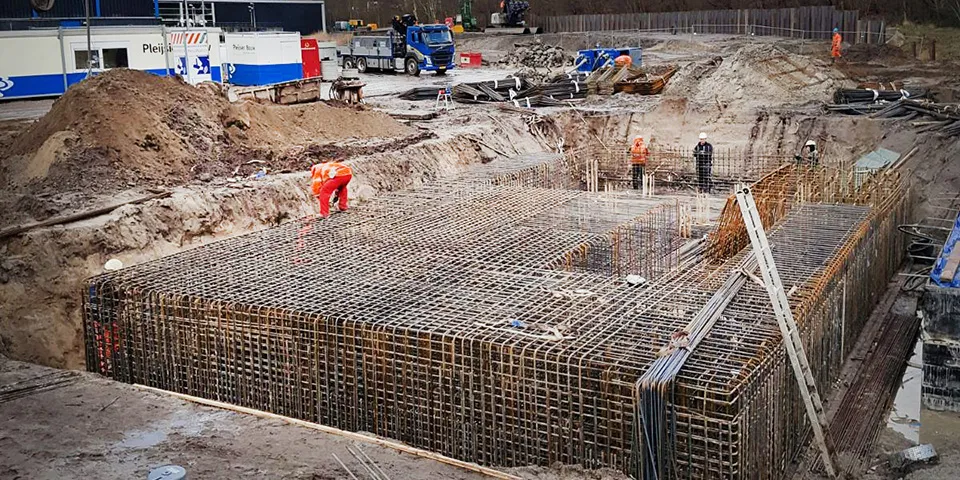
The first Van der Valk hotel in Amsterdam is also an impressive feat, both aesthetically and technically. Balvert Betonstaal has applied its expertise to the unique prestressing method and the additional reinforcement for the first seven floors, translating them into a solution that is easy to understand and build.
The hotel’s first seven floors are cast in situ, while the upper section, containing the hotel rooms, is being built from precast elements. “The structural design of the first seven floors was produced by a British engineering firm,” says Robin Aantjes of Balvert Betonstaal BV. “This is the first time this method has been used in the Netherlands. In this case, it was chosen to reduce weight and allow the floors to be made thinner. At the request of Van Muijen Betonbouw, we reviewed the reinforcement drawings and translated them into a solution that could be built.”
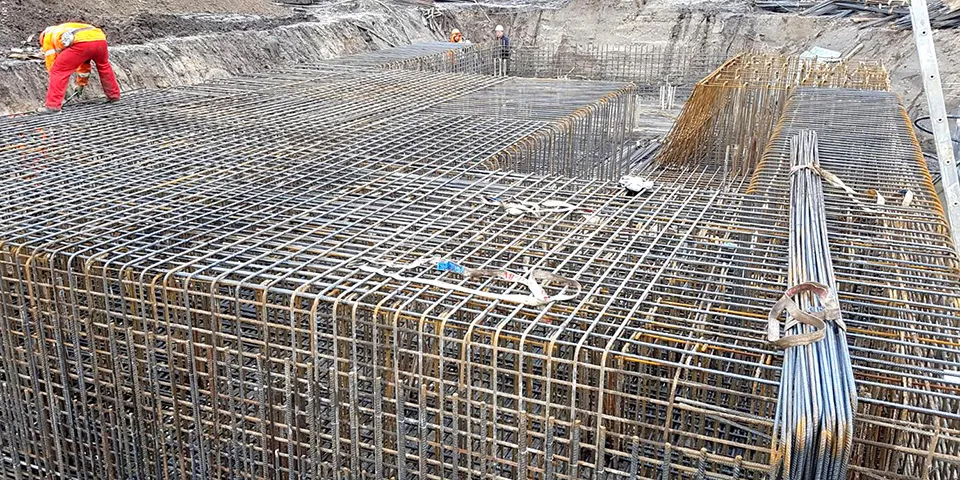
The project as a whole, including the wall reinforcement, involves 850 tonnes of reinforcing steel.
Fine-tuning
Balvert Betonstaal has specialised in supplying and fixing reinforcing steel for 54 years. Its work is carried out at a modern, exceptionally tidy reinforcement plant in Nieuwkoop. According to Aantjes, the British engineering firm’s drawings needed some fine-tuning, as certain details would be difficult to achieve on site. In particular, he means the combination of tendons and punching shear reinforcement (reinforcement cages) around the columns. “Each column, 25 in total, has seven to nine reinforcement cages around it, mostly of different dimensions, attached to a bottom mat. The floor edges are fitted with hairpin cages, with the tendons placed above them. What is unique by Dutch standards is that no top reinforcement has been used. This is inherent in the chosen structural system, but it still takes some getting used to, even for our steel fixers.”
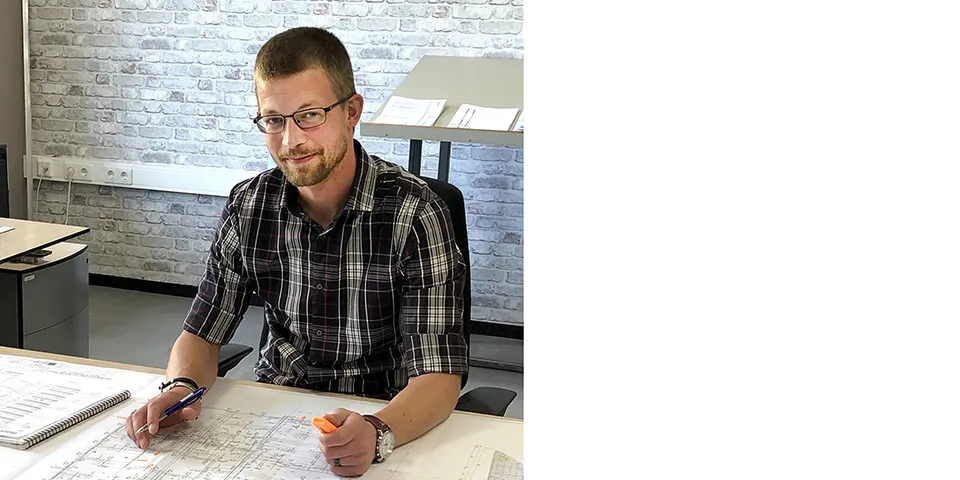
Robin Aantjes, work planner at Balvert Betonstaal BV.
A challenging job
During construction, the main challenge, according to Aantjes, was ensuring that the right cages were used around each column. “We had already allowed for this during the engineering phase, with detailed bending schedules and reinforcement cages, all numbered, of course.” Fehmi Guler, foreman of the steel fixers, agrees: “It was a very labour-intensive job for us. This was due not only to the unique British-designed prestressing method, but also to the shape of the building. The sharp corners, as the hotel has a triangular design, also make the reinforcement work very labour-intensive. Our team worked on the project for a year.” Although no traditional top mat was used, a substantial 512 tonnes of reinforcing steel were still incorporated into the floors. And that is just the first seven floors. “As a result, the floor slabs are relatively thin, at 280 millimetres. The only exception is the transfer floor on the seventh level, which is considerably thicker at 90 centimetres,” says Aantjes. “Top reinforcement was used in this floor. That makes sense, as it forms the basis for the entire upper section. The project as a whole, including the wall reinforcement, involves 850 tonnes of reinforcing steel.”
Vraag over dit verhaal? Stel je vraag
Wie eraan werkte
Hotel Van der Valk Amsterdam in Amsterdam
- hoofdaannemerPleijsier Bouw
- onderaannemerVan Muijen Beton
- voorspanningInterspan
- hotelketenVan der Valk
- wapeningsstaalBalvert Betonstaal BV
Blijf dit volgen
Bij een nieuw verhaal krijg je een e-mail. Geen account nodig.
- ProjectHotel Van der Valk Amsterdam
- OnderwerpProjects
- BedrijfBalvert Betonstaal BV