Taking CO2 out to sea
Tekst Tjerk van DuinenBeeld Porthos
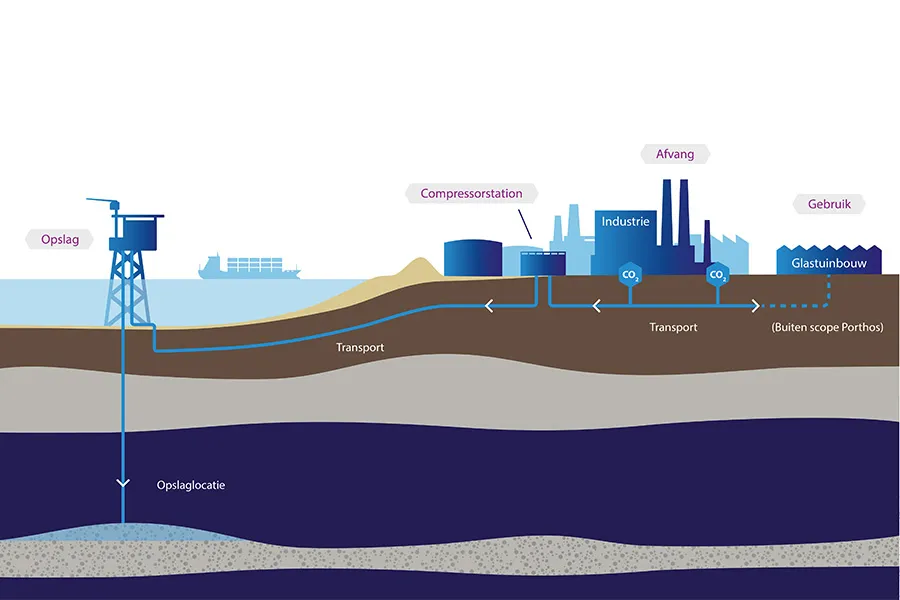
Porthos compressor station is a central link in CO2 storage beneath the North Sea
From 2026, CO2 from a number of industrial companies in the Rotterdam port area will be captured, transported and stored in depleted gas fields beneath the North Sea. Several initiatives have been set up to deliver the complex transport infrastructure, with some working together. One of them is Porthos, a joint venture between Gasunie, Havenbedrijf Rotterdam and EBN, comprising a long onshore pipeline, a compressor station and an offshore pipeline through which CO2 is pumped into a depleted gas field. Near the far end of the Tweede Maasvlakte lies the heart of the project: the compressor station, which brings the collected CO2 to high pressure and the required temperature.
Alongside Aramis and CO2Next, Porthos is one of the partnerships aimed at capturing CO2 and storing it underground. This Carbon Capture and Storage (CCS) is intended to make a major contribution to reducing CO2 emissions, particularly those from industry. After the Raad van State gave the go-ahead for Porthos in August 2023, construction of the onshore pipeline began shortly afterwards. From Vondelingenplaat, it follows a highly challenging 30 km route through the port area, mainly underground, passing beneath a canal and a sea defence at depths of up to 50 m. A 22 km pipeline is currently being laid from the compressor station to a drilling platform, which will pump the CO2 injection wells at a depth of 3 to 4 km.
Compressor station
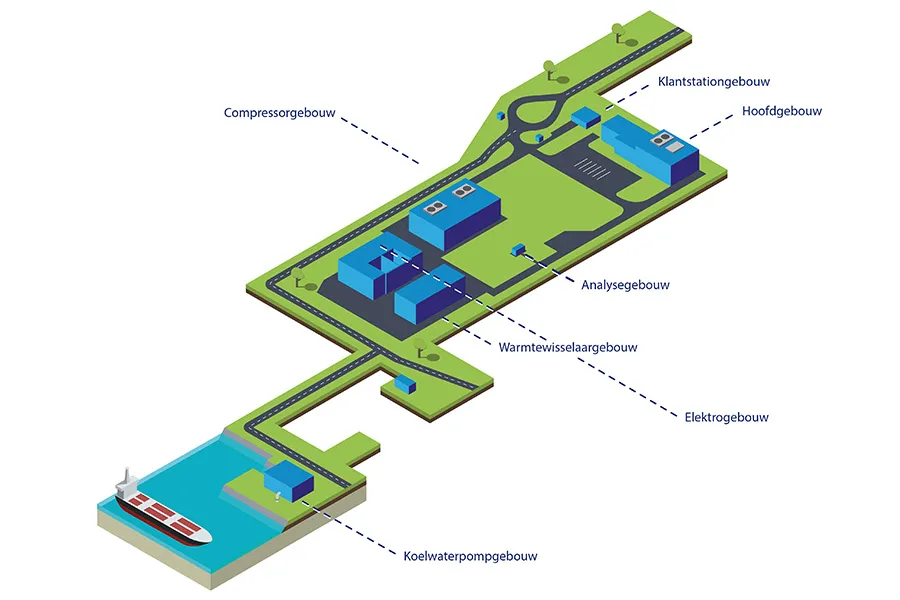
The 2-hectare compressor station site is wedged between the ECT Euromax container terminal and the Maasvlakte Olie Terminal. “CO2 will arrive here through a 42-inch pipeline at 30 bar,” begins Reinier Lissenberg, construction manager for the Porthos compressor station. “At the compressor station, the gas is filtered and brought to a pressure of 180 bar. This is done using three compressors, one of which serves as a standby. The building has already been prepared for another three compressors for Aramis.”
Heat exchanger
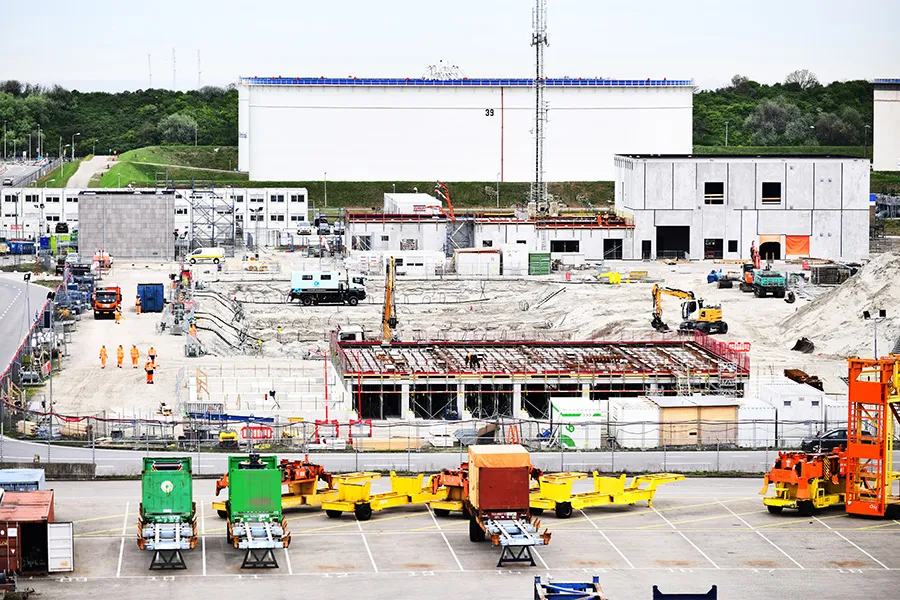
Compression generates heat, and the compressors are cooled to prevent temperatures from becoming too high. “To control the temperature, the compressors are connected to a closed cooling system. In a separate heat exchanger building, this closed system is cooled with water drawn from the Yangtzekanaal by a cooling water pump building. Waste heat from the heat exchanger will be sent to the nearby GATE Terminal, where LNG is converted from liquid to gas. Next to the heat exchanger building is the ‘electrical building’, housing the transformers. Here, transformers step down 66 kV to 11 kV and 440 V to supply all the equipment.”
Underwater concrete
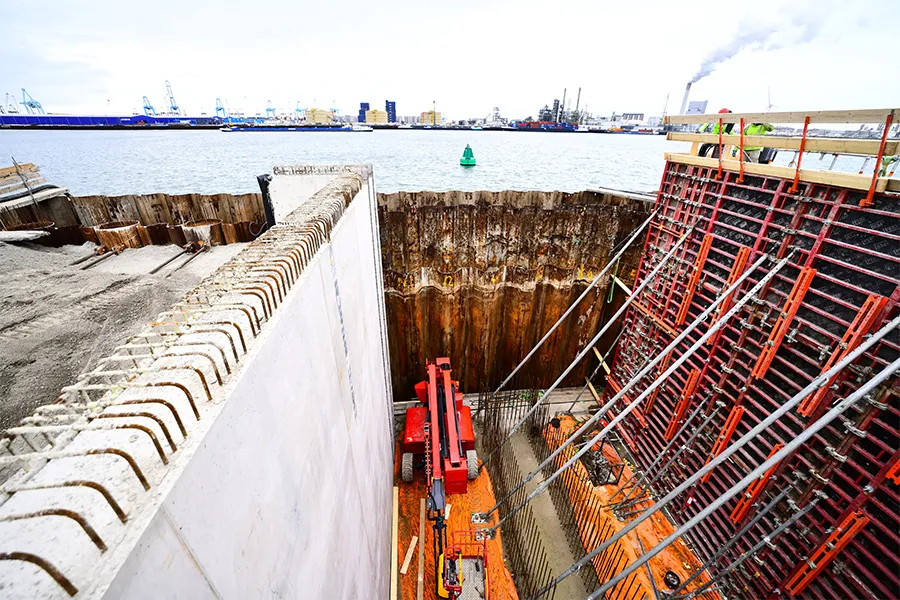
Construction of the compressor station was awarded through a European tender to coordinating contractor Bonatti, with G. van der Ven BV Aannemingsbedrijf acting as the coordinating and executing contractor for the cooling water pump building. Lissenberg says: “The deepest point is the basement of the cooling water intake at the Yangtzehaven. Here, in addition to extending a section of quay wall, an excavation was formed using sheet piles. A foundation slab was then poured using underwater concrete at a depth of 9 m, allowing the concrete basement walls to be built in a dry excavation. The superstructure of the cooling water pump building is made of precast concrete.”
Stabilisation mattress
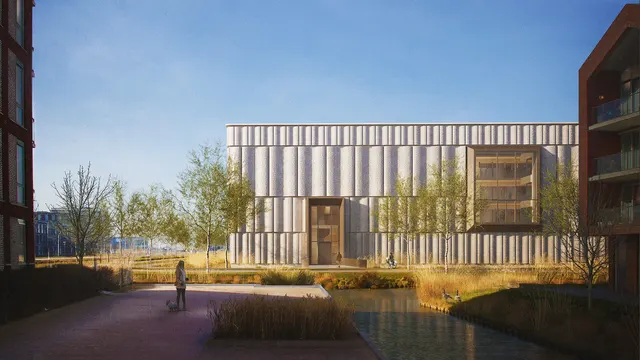
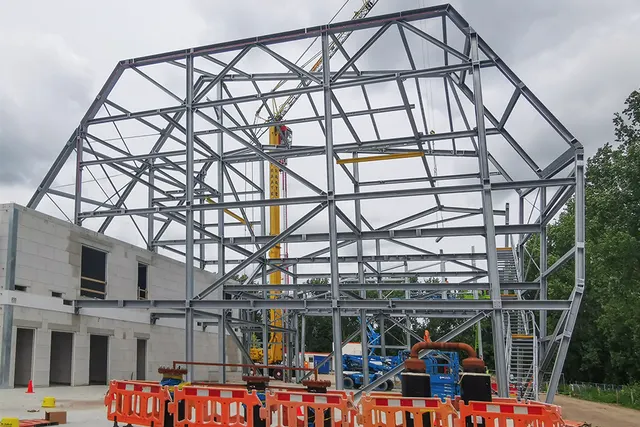
The highest structure will be the compressor building, reaching 13 metres. “This is also the only building on piles, all the other buildings have shallow foundations,” Lissenberg continues. “The compressors and interstage coolers, together with all the associated equipment, form a heavy assembly that generates various loads, both static and dynamic. Some of the 806 CFA piles, cast-in-situ piles drilled using a continuous flight auger, ed., support a stabilisation mattress made of geotextile and aggregate, on which the compressors sit. This mattress absorbs a large proportion of the dynamic loads. Like the heat exchanger building, the superstructure of the compressor station will be constructed from a steel frame and blue sandwich panels. The superstructures of the other buildings are made from precast concrete elements. The electrical building received a ceramic facade finish with Mosa tiles in an attractive sand colour. This will help all the buildings blend into the dune landscape.”
Een zakelijke vraag aan Van der Ven? Neem contact op
Bedrijven in dit verhaal
Blijf dit volgen
Bij een nieuw verhaal krijg je een e-mail. Geen account nodig.
- ThemaMinder CO2 in beton en staal
- OnderwerpProjects
- BedrijfVan der Ven