










Emmen car park Willinkplein | Extension of Willinkplein car park presents logistical and technical challenges A dynamic project in the heart of Emmen
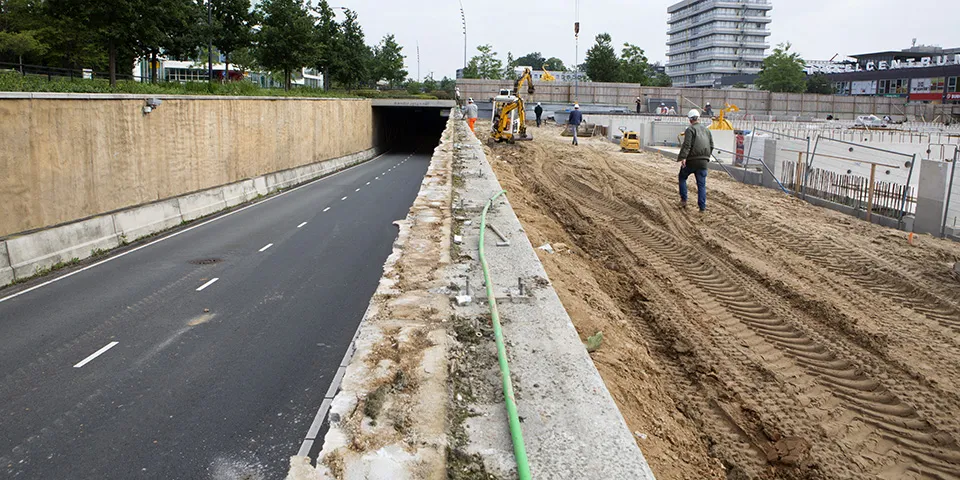
Rijssen-based Akor specialises in commercial, retail and inner-city construction. The latter category includes not only homes and apartment buildings, but also car parks. In Emmen, Akor is working on an extension to a car park at Willinkplein, with commercial space, a hotel, restaurants and two penthouses above it. The shell of the first commercial spaces is due for completion in mid-January 2020.
The municipality of Emmen purchased the car park extension from property developer Peter van Dijk, who came up with the plans. The project began in 2016, with the first design team meeting held in November that year. Maurits Nijenstein of Goudstikker, de Vries also joined the project at that time. Goudstikker, de Vries is an engineering consultancy specialising in advice on housing and associated commercial building projects, mixed-use residential and workplace developments, and purely commercial buildings such as offices, schools, theatres, multifunctional centres, care centres and business complexes. The consultancy uses the NEN-EN-ISO 9001 quality management system when developing its projects. The existing car park beneath Willinkplein, built in 2004, was also engineered by the firm. The new section is being built seamlessly against it.
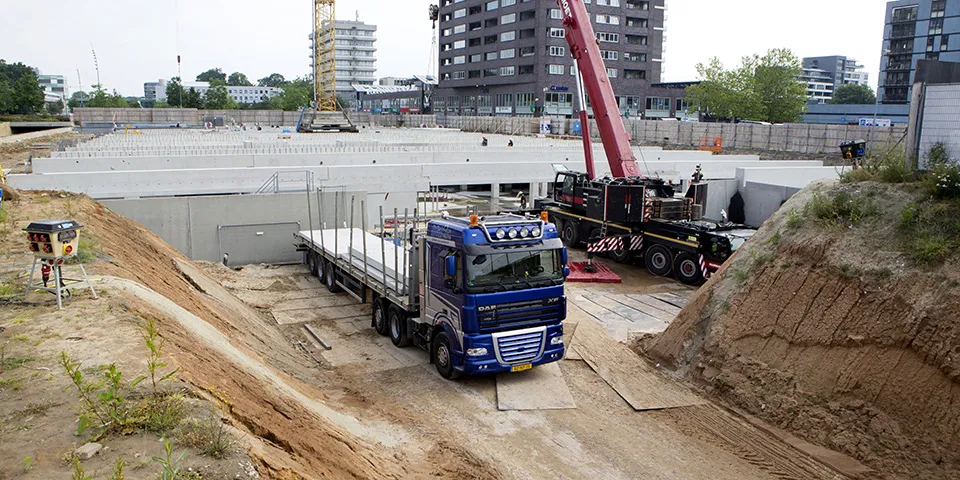
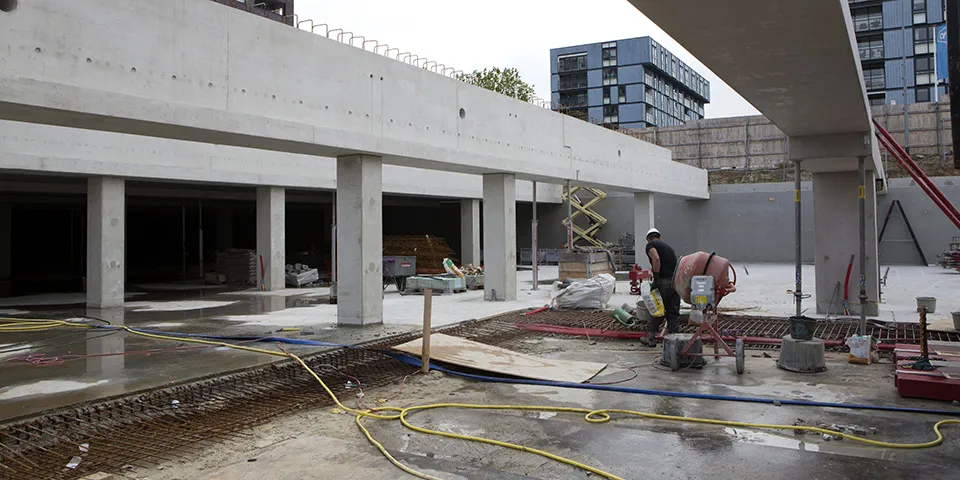
The main structural frame of the car park is designed with two columns per grid bay.
‘Changes are part and parcel of the times’
Goudstikker: de Vries has worked with Akor for many years. Akor is clearly no run-of-the-mill contractor. “We specialise in unusual projects. Where others say ‘no’, we say ‘yes’. That is partly because we have a flat organisational structure, which enables us to respond quickly to clients’ needs,” says project manager Jan Nijkamp. Initially, the plan was for a car park with a two-storey superstructure. Last year, however, this was changed to six storeys. “We see the structural changes required by the extension as part of the project’s dynamic. Changes are part of the times, it’s the drive to develop. Fortunately, though, such major changes at such an advanced stage of a project are rare.” No more can be added on top of the extension either. “The structure has been fully exploited,” says Nijenstein. “The building has shallow foundations, on a large concrete slab with thickened strips, and the ground pressure would become too great. It was a structural challenge. The new basement and part of the existing one support the building, but the adjacent tunnel wall does not. That is why the concrete beams in the new section are so substantial. The structure nevertheless had to match the ‘look and feel’ of the existing section, and we have achieved that successfully.”
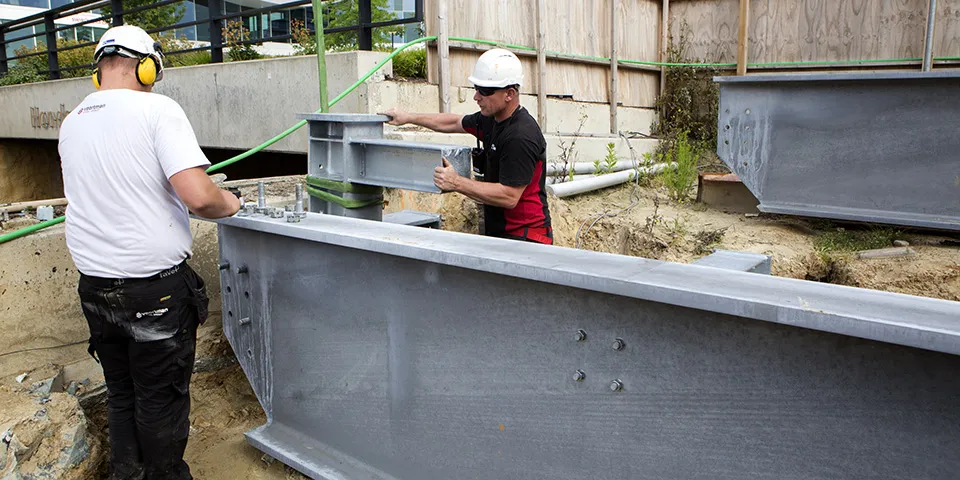
The building has shallow foundations.
For Goudstikker: de Vries and Akor, changes requested by the client shortly before completion are also more the rule than the exception. “For example, a box-in-box construction may still be needed to meet the acoustic requirements for certain commercial spaces. We are happy to accommodate that. The structure is designed to allow for changes. The primary structure is a braced steel frame. This means the entire building can be reconfigured and stripped out if necessary, leaving just a grid of columns. Only the hotel has a number of wind-resisting walls, which are unavoidable given its height.”
A view of the end result
The municipality of Emmen has a clear view of the end result throughout the design and construction of the project. Akor uses BIM throughout and communicates with all the parties involved through it. The municipality of Emmen has also installed a webcam, which allows construction activities to be followed in real time via www.emmeninbeeld.nl.
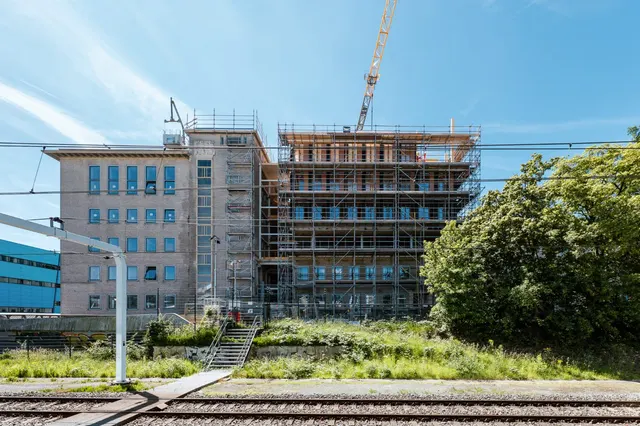
Construction of the Willinkplein Garage extension, with its six storeys above, is taking place in the centre of Emmen. This naturally creates logistical constraints, as well as technical ones. There is a block of flats on one side and a road tunnel on the other. “And the tunnel was quite a challenge,” say Nijenstein and Nijkamp. “The construction method used for the old car park was not possible because of the grout anchors for the tunnel wall, which was built later. An external party was brought in to assess the impact of the new construction on the adjacent tunnel wall and to determine and calculate the right construction method. The solution chosen was stabilisation using CSM walls. These ‘temporary’ retaining walls have to withstand the pressure from the block of flats and the depth of the tunnel during construction. This was a major challenge because the two new entrances, which descend about eight metres below ground, are on the side of the block of flats and the tunnel. The deepest part of the building is on the hazardous side of the car park.” Heavy steel strutting frames were therefore installed at various levels between the CSM walls to transfer the lateral earth pressure, says Nijkamp. “The building extends above the tunnel wall, but the foundations are nine metres further away. They could not be placed any closer because of the existing grout anchors for the tunnel wall structure. The solution was a steel cantilever with HE1000M beams, attached to the new precast concrete beams of the car park basement deck.”
Tight tolerances and narrow margins
The cantilever has tight tolerances and narrow margins. Everything fits to the centimetre. The main structural frame of the car park is designed with two columns per grid bay, positioned neither on the roadway nor in the parking spaces. This results in large columns and heavy beams. “In terms of cost, it would of course have made sense to use more columns and smaller beams. The client wanted the new section to have the same appearance as the old car park, though, as open as possible. With more columns, usability and sightlines would naturally be much poorer,” say Nijenstein and Nijkamp.
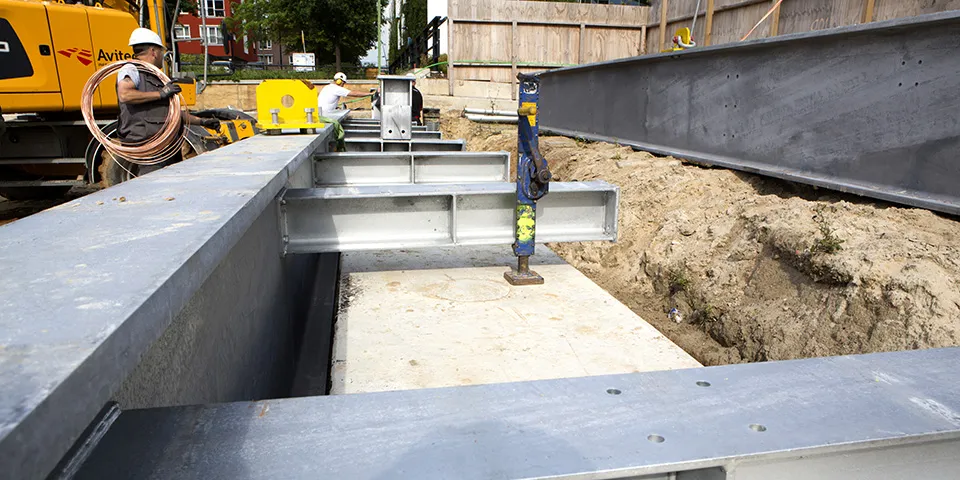
The basement supports the building.
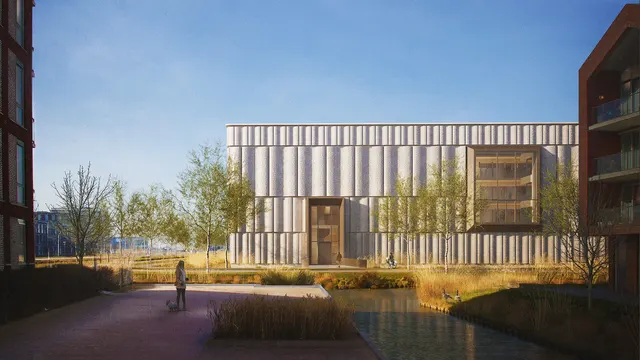
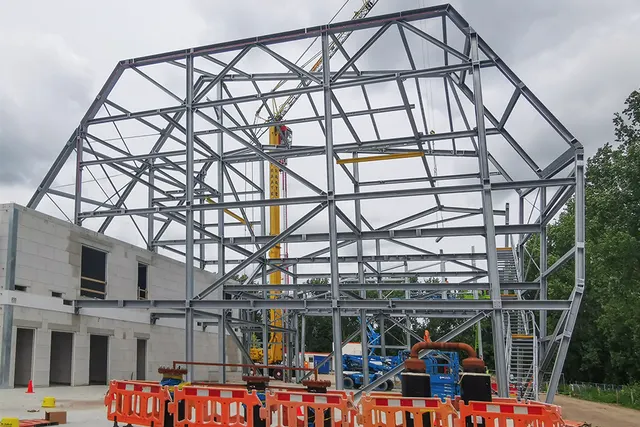
The walls around the stair and lift cores have a textured finish, giving them the same appearance as the older section. This also fulfils the client’s wishes. The superstructure comprises a composite steel frame with concrete hollow-core slabs topped with a structural concrete layer, and precast concrete stability cores. The steel frame is braced and has many moment-resisting connections, minimising the need for wind bracing. This creates open commercial spaces that can be freely laid out. The façades will be infilled with precast steel-frame piers with a relief and brick-like texture, between which transparent aluminium curtain walls and window frames will be installed. The commercial spaces will generally be handed over to tenants as shells, although requests for complete fit-outs are already coming in. The communal areas and hotel rooms will be fully fitted out and equipped with all building services.
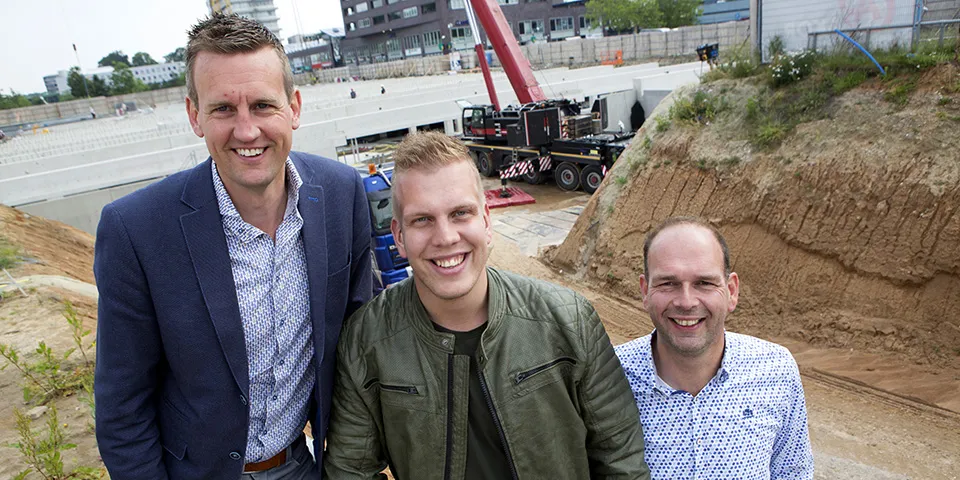
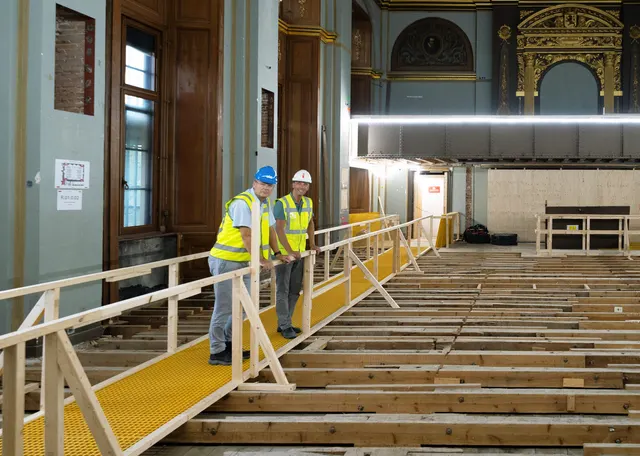
Maurits Nijenstein (Goudstikker: de Vries), Jarno Voortman (Akor) and Jan Nijkamp (Akor).
Vraag over dit verhaal? Stel je vraag
Wie eraan werkte
Parkeergarage Willinkplein in Emmen
- projectontwikkelaarPeter van Dijk
- prefab betonelementenHolcon
- ingenieursbureauLincon
Blijf dit volgen
Bij een nieuw verhaal krijg je een e-mail. Geen account nodig.
- ProjectParkeergarage Willinkplein
- OnderwerpProjects
- BedrijfPeter van Dijk