Europe’s largest hydrogen plant runs on green electricity
Tekst Tjerk van DuinenBeeld Shell
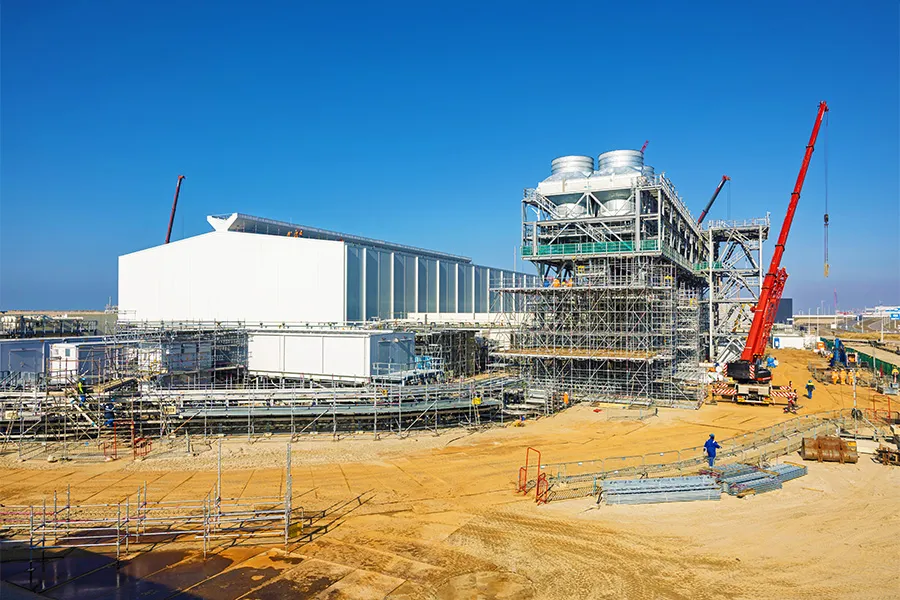
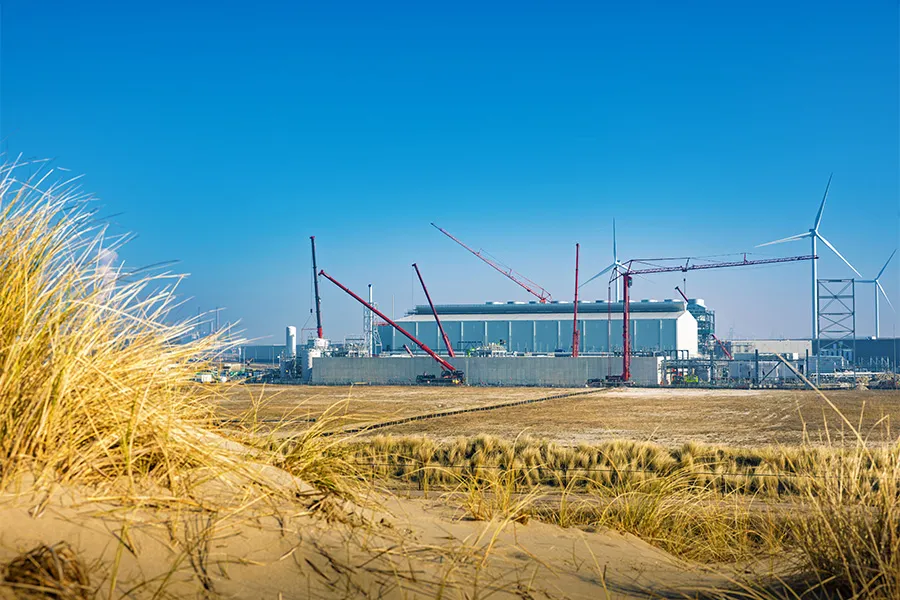
Construction of Europe’s first green hydrogen plant is nearing completion in the dune landscape of the Tweede Maasvlakte. Under the name Holland Hydrogen 1 (HH1), Shell will use electricity from an offshore wind farm to produce an average of 60,000 kilograms of hydrogen per day, which it will use at its refinery in Pernis. The refinery currently runs on grey hydrogen, produced using fossil fuels. This marks an important step for Shell in making these facilities more sustainable and reducing CO2 emissions. At a later stage, other industries could also be supplied with green hydrogen via a pipeline.
Industry accounts for roughly half of energy consumption in the Netherlands. It is also responsible for a quarter of CO2 emissions. This needs to come down, and one alternative to fossil fuels such as oil and natural gas is hydrogen. That is why the Netherlands is developing hydrogen infrastructure.
Electrolysis
The plant uses alkaline electrolysis to produce hydrogen, a process that splits water into hydrogen and oxygen using an electric current. “This takes place in the ten electrolysers, with a combined capacity of 200 megawatts, housed in a large hall on the site,” says Bas van de Werff, project manager for Holland Hydrogen 1 at Shell. “This and the other installations on the site run on electricity generated by an offshore wind farm that Shell has developed in a joint venture with Eneco off the coast of Egmond aan Zee. The wind farm is connected to the 380 kV Maasvlakte substation via an existing cable link. We use this green electricity, together with water from Evides, to produce green hydrogen.”
No precast elements
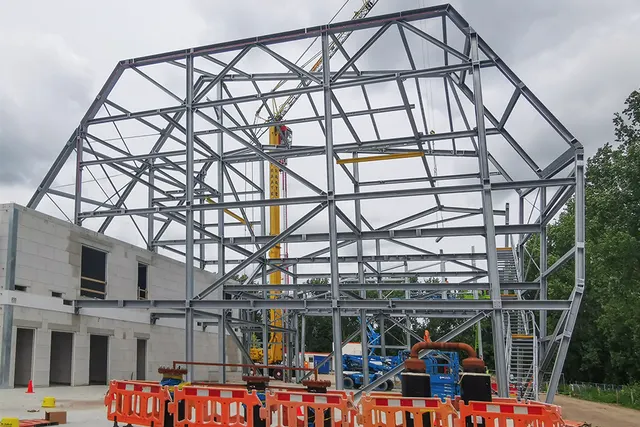
For HH1’s core operation, electrolysis, Visser en Smit Bouw has built a large electrolysis hall in concrete and steel, with 33 large lattice trusses and 4,000 m² of roof and wall cladding. Van de Werff says: “The floor is a thick concrete slab and, apart from a few blast walls, everything else is built in steel. Because of the many viaducts you have to cross to get here, and the transport restrictions in place, it is difficult to use large modules. That is why almost no precast elements are being used in the construction.”
Blast walls
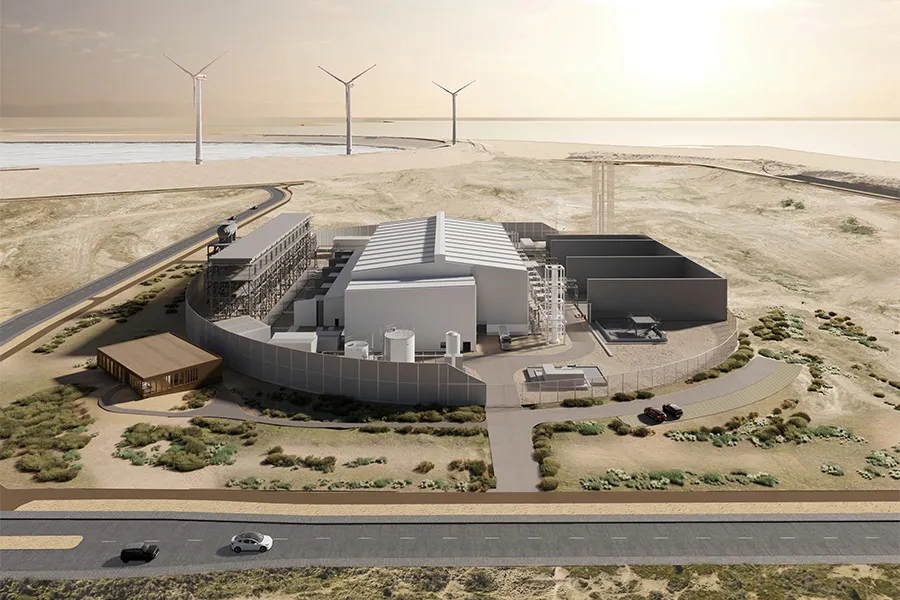
After being produced in the electrolysis hall, the hydrogen is carried south via three pipe racks to two compressors, which compress the gas to 50 bar. “This 60 megawatt installation is the only part of HH1 that imposes a dynamic load on its foundations,” explains Van de Werff. “To create a stable base, a six-metre-thick floor was poured for the compressors using 2,000 cubic metres of concrete, on compacted ground. Bays have been built on top, with blast walls 80 centimetres thick and between eight and ten metres high. In exceptional circumstances, a leak in a compressor could cause an explosion, which must not affect our neighbours. All the other buildings and installations are supported on pad foundations. This reclaimed land offers extremely stable ground conditions.”
Arm-thick cable
On the north side of the electrolysis hall stands an impressive 850-tonne steel structure. “That is the framework for the air coolers,” explains Van de Werff. “They allow us to dissipate the waste heat generated by the electrolysis process. Ideally, we would reuse that waste heat in the port, but there is no infrastructure here yet. It could become a viable business case if heat users set up on adjacent plots or a connection to the district heating network is installed. The main electrical installations are located on the east side of the electrolysis hall. The arm-thick 380 kV cable enters the substation here, where the voltage is stepped down to 33 kV. Five transformers next to the electrolysis building then convert it to 670 V DC. This all requires a lot of heavy cabling, laid in culverts. You want to get the routing right from the outset, because you will not be rerouting it later.”
Scandinavian-style main building
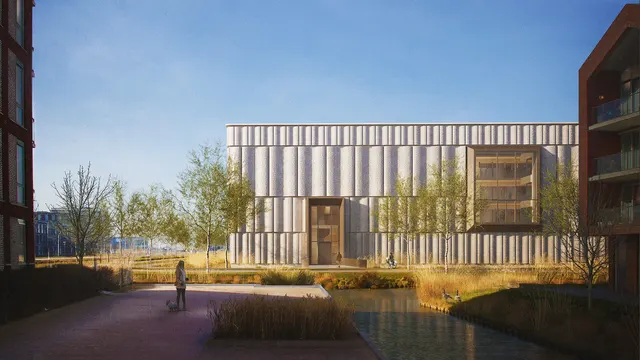
The compact, densely built-up site also houses an oxygen vent stack, an emergency hydrogen vent stack, a metering station, a small water-treatment building and an annex containing servers. “And, of course, the main building with all the control systems,” adds Van de Werff. “It stands by the roundabout, outside the fence around the plant. The nice thing is that we are building the superstructure entirely from reused materials on top of the concrete basement containing all the control systems installations. I think that is quite unusual for an industrial application. The design was inspired by a primary school that Visser & Smit Bouw built in central Rotterdam. Together with timber specialist De Groot Vroomshoop, we are creating a presentable main building whose use of wood is intended to give it a Scandinavian feel. It also fits beautifully into the dune landscape of the Maasvlakte. The circular boundary, which was still shown on the drawings as a solid sand barrier, will probably simply be an open fence.”
“Initially, the hydrogen will be supplied to our refinery and chemicals plant in Pernis,” concludes Van de Werff. “We want to extend this to other industrial customers as soon as possible. Once more trucks run on hydrogen, we could supply them with green hydrogen too. With this investment, Shell is taking the lead in the production of sustainable energy.”
Vraag over dit verhaal? Stel je vraag
Wie eraan werkte
Holland Hydrogen 1
- opdrachtgeverShell
- EngineeringWorley
- AannemerVisser en Smit Bouw
- StaalwerkDe Kok Staalbouw
Blijf dit volgen
Bij een nieuw verhaal krijg je een e-mail. Geen account nodig.
- ProjectHolland Hydrogen 1
- OnderwerpProjects
- BedrijfShell
- BedrijfWorley
- BedrijfVisser en Smit Bouw
- BedrijfDe Kok Staalbouw