Largest onshore wind farm is being built near Zeewolde
Tekst Tjerk van DuinenBeeld GMB, Dura Vermeer
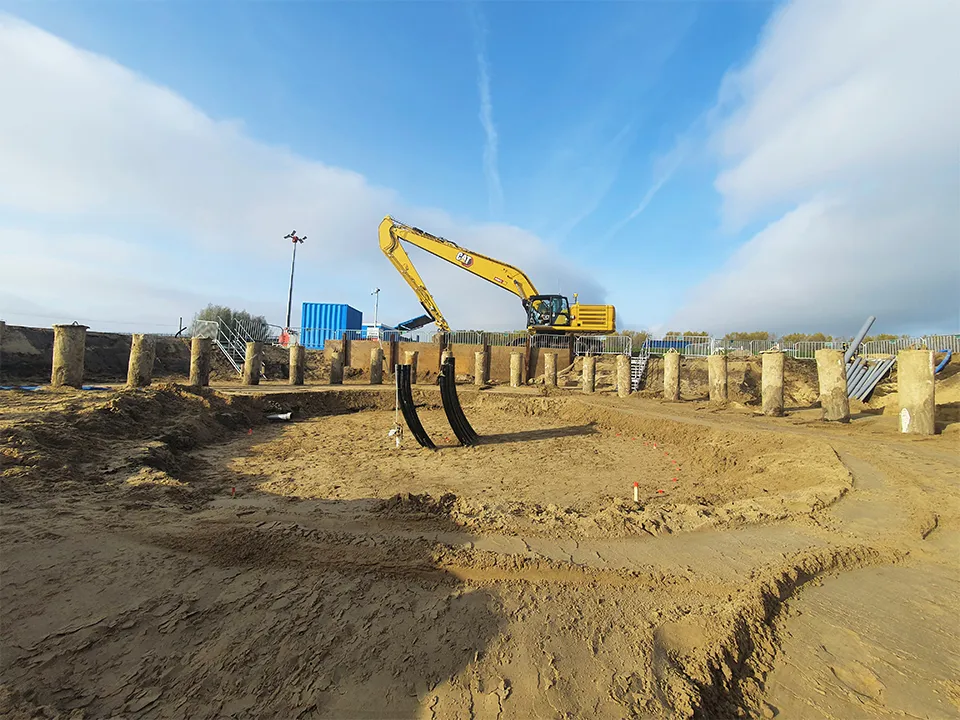
Construction is under way in Zuidelijk Flevoland on the largest onshore wind farm in the Netherlands. Across an area of 300 square kilometres between Zeewolde and Almere, 220 old turbines scattered across the landscape are being replaced by 91 large turbines arranged in rows. From 2022, Windpark Zeewolde is expected to generate two and a half times as much power as the old turbines, all of which are due to be dismantled by 2025. What makes the project special is that the client for 83 of the 91 turbines, Windpark Zeewolde BV, is owned by more than two hundred farmers, residents and landowners from Zeewolde. This makes Windpark Zeewolde Europe’s largest community-owned project.
The wind farm is being delivered by Hitachi-ABB, which is building the substation, Vestas, the wind turbine supplier, and Windcombinatie Dura Vermeer-GMB, which is responsible for all the substructures and infrastructure. Henk Ruiterkamp, construction manager at GMB: “To be precise, we are building the concrete foundations with cast-in anchor cages, creating permanent crane hardstands for each turbine, installing the cabling and constructing all the roads needed to access the turbines.”
Permits
At 220 metres, the towers planned for the south-westernmost locations are the tallest. Ruiterkamp: “That is the maximum height that can be built at that location. The other turbines have lower tip heights of 150 or 160 metres because they are in the approach path to Lelystad Airport. You have to take a lot of factors into account and go through a series of permit procedures before you can build something like this. Wind turbines are also granted temporary permits, which take effect from the date they are issued. So building quickly is essential if the BV is to generate a return. This is also one of the main objectives for everyone involved. Of course, we make no concessions on safety or the environment, and we also want to keep all the stakeholders in the area satisfied. In short, GMB’s slogan, ‘challenges bring people together’, certainly applies here.” Windcombinatie is on schedule: the infrastructure is already in place, the substation has been connected and the first wind turbines will be standing in June 2021.
Parametric design
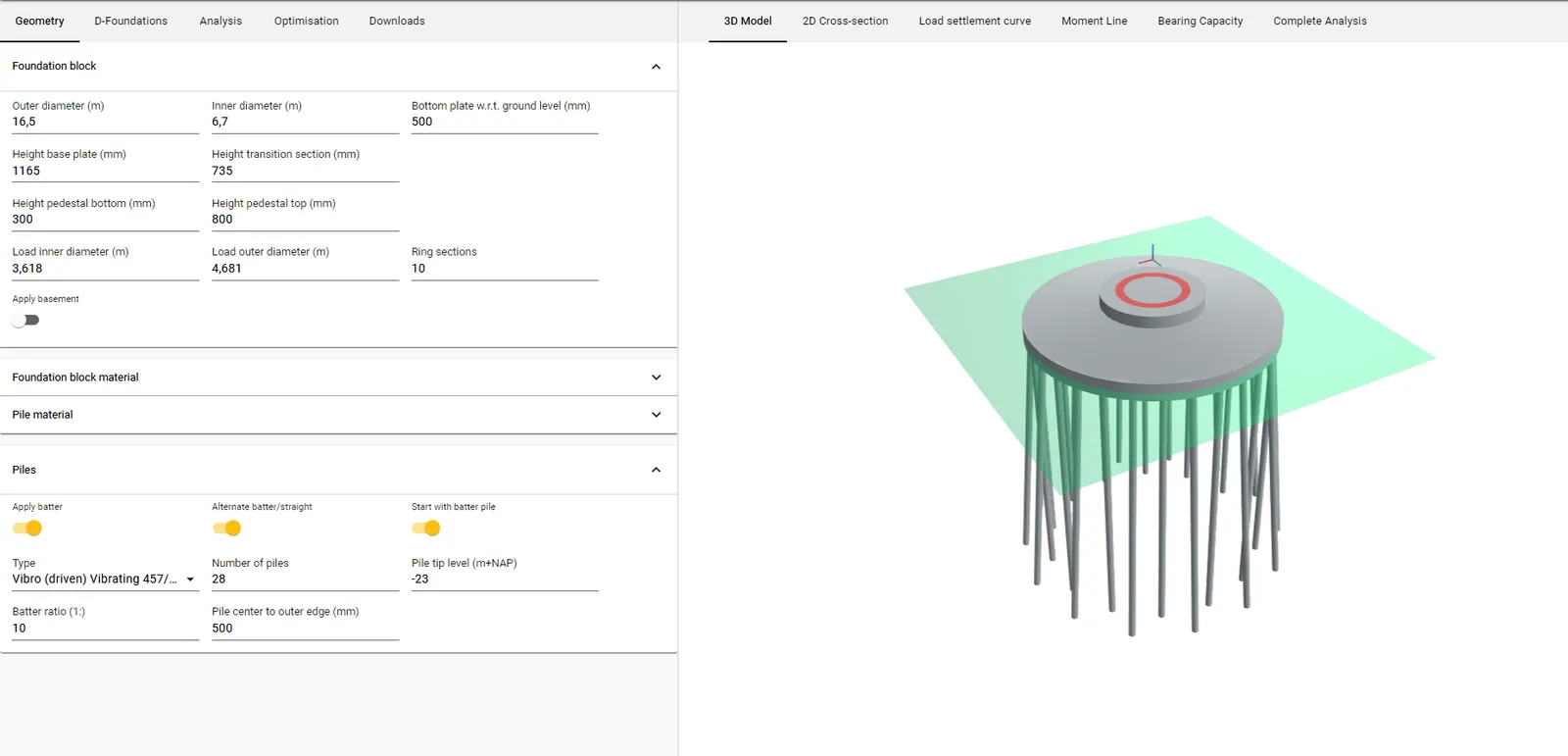
Parametric design is being used for the structural design of the turbine foundations. Bart Zevenhoven, junior structural engineer at Dura Vermeer: “It is a logical way of working when you have to design and build 91 foundations for four different types of wind turbine. These foundations can be seen as standard objects with the same shape, with forces transferred in the same way each time. The differences lie in their dimensions and the ground conditions. Together with one of our software suppliers, we have developed a parametric tool that allows us to quickly calculate the required foundation dimensions and pile foundations for each location. We enter the set of cone penetration test data for the local ground conditions each time, and, based on the loads specified by the turbine supplier, we can determine the required tensile and compressive capacity of the foundation piles and check the requirements for rotational and lateral spring stiffness. The forces involved in a turbine like this are extraordinary, with moments reaching more than 100,000 kNm.”
Vibro piles are driven for the turbine foundations: 15 metres below NAP for the smaller models and up to 20 metres below NAP for the 220-metre-high turbines. The structures therefore comply with the Eurocodes. The loads applied to the foundations, including safety factors, comply with IEC 61400-1. This is broadly comparable to consequence class CC2.
Individual interests
For the time being, Dura Vermeer and GMB staff will still be working in the vast polders near Zeewolde. Ruiterkamp: “We will certainly be busy building here for some time yet. But we also have to take people’s interests into account. It is a complex project in part because you are working for a collective client, but carrying out work in the back gardens of individual parties.”
In 2022, Windpark Zeewolde will generate 850,000 MWh per year. Windcombinatie Dura Vermeer-GMB is using 43,000 m³ of concrete and 4,120 tonnes of reinforcing steel for the foundations, and has built 44 km of new roads, as well as 338 km of 33 kV cable and 110 km of fibre-optic cable.
Vraag over dit verhaal? Stel je vraag
Wie eraan werkte
Windpark Zeewolde in Zeewolde
- opdrachtgeverWindpark Zeewolde BV
- onderstationHitachi-ABB
- leverancierVestas
- uitvoeringWindcombinatie Dura Vermeer-GMB
Blijf dit volgen
Bij een nieuw verhaal krijg je een e-mail. Geen account nodig.
- ProjectWindpark Zeewolde
- OnderwerpProjects
- BedrijfWindpark Zeewolde BV
- BedrijfHitachi-ABB
- BedrijfVestas
- BedrijfWindcombinatie Dura Vermeer-GMB