Zaandam, Wilhelminasluis | A piece of Zaandam is back!
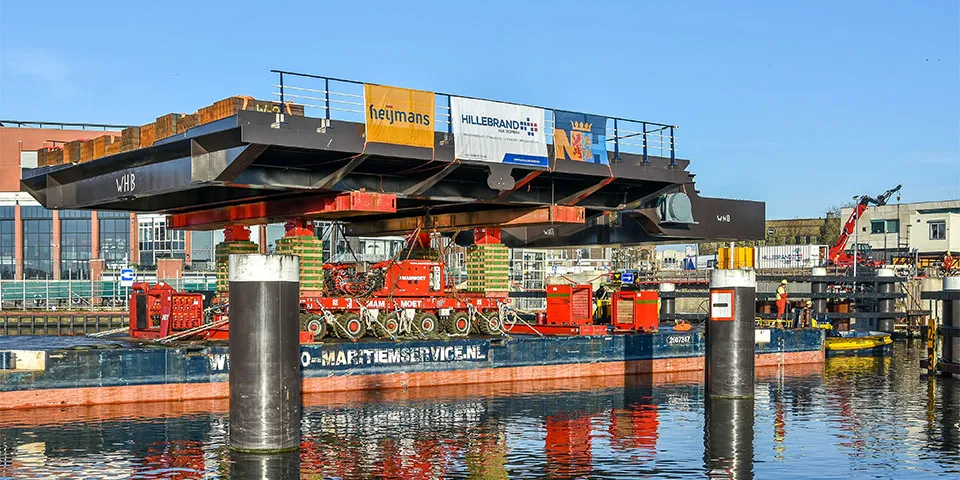
The installation of the Wilhelminabrug and Beatrixbrug marks the completion of two major milestones in the Wilhelminasluis Zaandam project. The Wilhelminasluis is the main crossing of roads and waterways in the heart of Zaandam. The lock on the Zaan was outdated, in poor structural and technical condition, and no longer met modern requirements. Working with, among others, bridge builder Hillebrand and on behalf of the province of North Holland, Heijmans replaced the old chamber lock with a new, modern navigation lock for commercial and recreational shipping. The lock has been made longer, wider and deeper.
“Hillebrand was involved from the outset in the design and decisions on how to carry out the work, both for the steel structure and for the bridge superstructure, to achieve the most efficient result,” says Martijn Kuzee, project manager at Hillebrand in Middelburg. Hillebrand’s bridge-building expertise, combined with the constructive approach taken by both Hillebrand and Heijmans and the positive interaction between the two parties, was vital to the project.
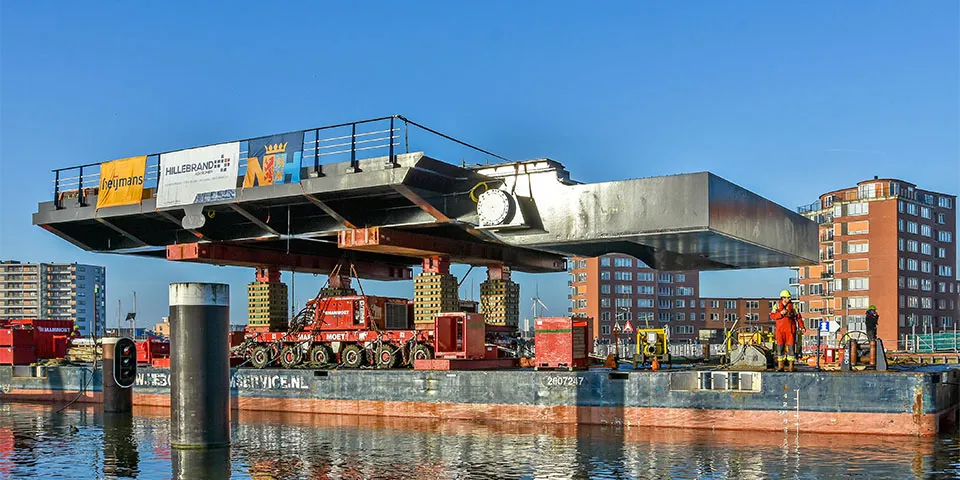
The Wilhelminabrug raised into position, ready for installation.
Smart planning minimises disruption
Kuzee: “Hillebrand was involved from start to finish in both the manufacture of the movable bridge sections, known as bascules, and the electromechanical drive system. The two bascules, weighing 180 tonnes and measuring 16 metres wide and 15 metres long, were fully prefabricated by Hillebrand in Middelburg. The railings and wearing course were also installed there.” Although the structure is relatively simple, working with components weighing 180 tonnes is a challenging task. “That’s why we called on our partner Mammoet,” Kuzee continues. “Mammoet also loaded the heavy bascules onto pontoons using a roll-on/roll-off operation and transported them 265 km by water.” By manufacturing everything in Middelburg and delivering it to Zaandam just in time, the amount of work required at the construction site was kept to a minimum. Smart planning also ensured that disruption to shipping and road traffic was kept as short as possible. “Even so, installing the bascules was quite a spectacle,” says Kuzee.
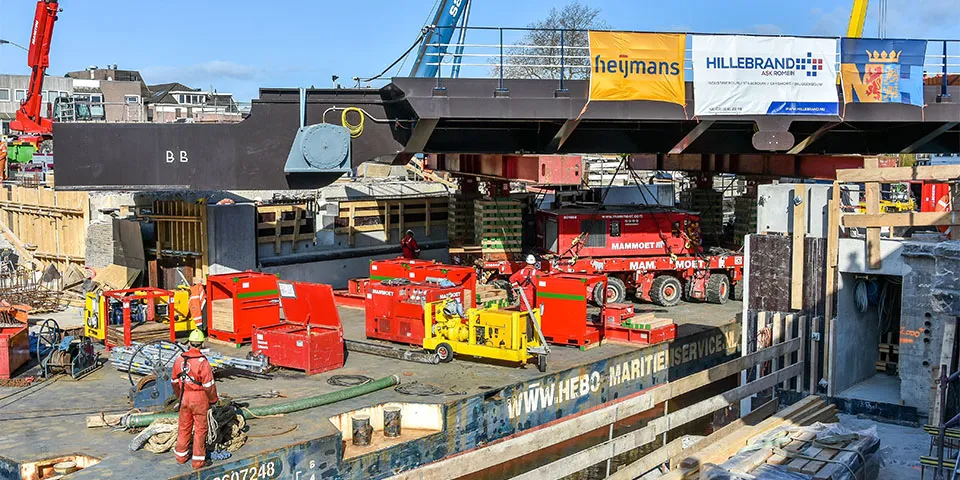
Halfway through rotating the bridge deck over the foundation.
Electromechanical drive system
The electromechanical drive system was also fully prefabricated by Hillebrand. “The most complex part was fitting the drive system into the very limited space in the basement. The basement was not enlarged during the renovation, but the requirements for the drive system had become more stringent, so making it fit was a real challenge. We managed to manufacture a drive system that was as compact as possible. Heijmans, in turn, built the basement’s thin concrete walls. Setting out and casting in the anchors for the drive system was a particular challenge for Heijmans: they were allowed to deviate by no more than a millimetre. This was achieved for every anchor, a fine example of the craftsmanship of the Heijmans and Hillebrand teams!”
A partnership to be proud of
Every part of this project shows that close collaboration is essential to bringing a project to a successful conclusion. Kuzee confirms that this was certainly the case here: “Working with Heijmans has been a pleasure, with mutual respect for each other’s interests. We know each other well, we often work together on projects and we know exactly what to expect from one another. The same goes for our collaboration with Mammoet.” It won’t be long before everything is finished and traffic is flowing on the Zaan again.
Vraag over dit verhaal? Stel je vraag
Wie eraan werkte
Wilhelminasluis in Zaanstad
- bruggenbouwerHillebrand
- roll-on/roll-off-actieMammoet
Blijf dit volgen
Bij een nieuw verhaal krijg je een e-mail. Geen account nodig.
- ProjectWilhelminasluis
- OnderwerpProjects
- BedrijfHillebrand
- BedrijfMammoet