Impressive concrete structure for the new Royerssluis
Tekst Roel van GilsBeeld Rinkoniên Royerssluis
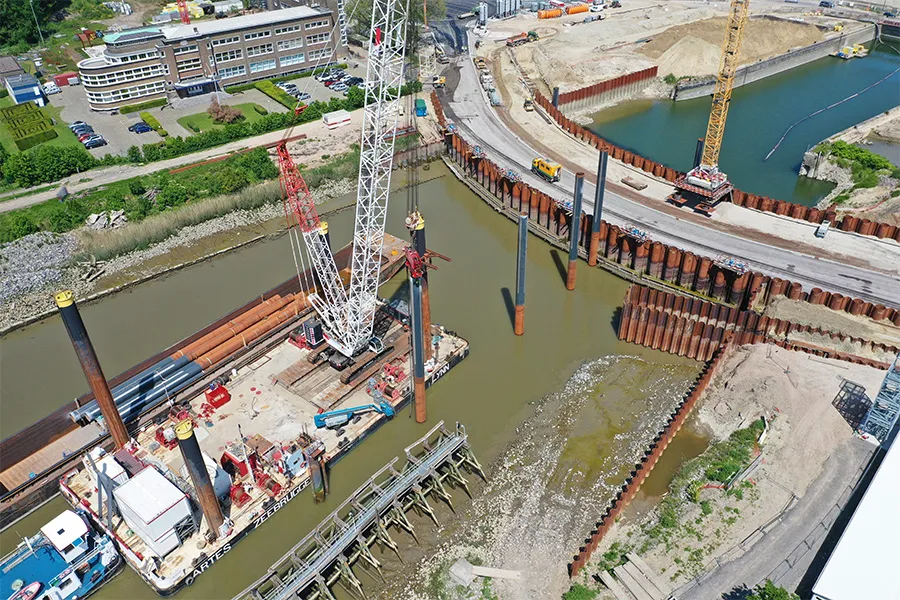
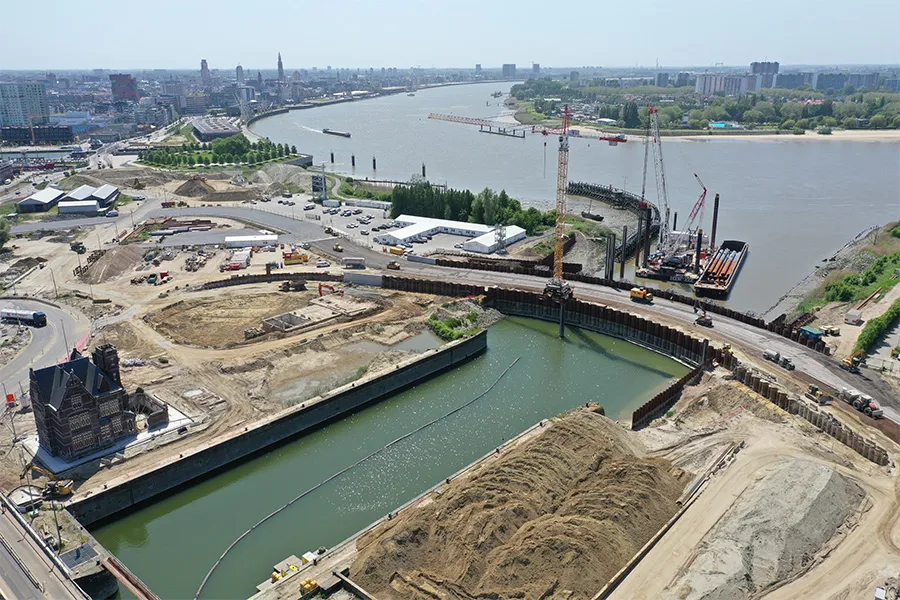
After more than a hundred years of faithful service, the Royerssluis in the Port of Antwerp was showing considerable signs of wear. The existing lock was also not designed to handle the ever-larger vessels passing through the complex. The Flemish government therefore decided to replace it with a new, larger lock. An enormously complex undertaking, taking a full seven years to complete, with the Oosterweelknoop construction site also just a stone’s throw away. Over the next two years, the focus will be on building the impressive concrete structure of the new lock.
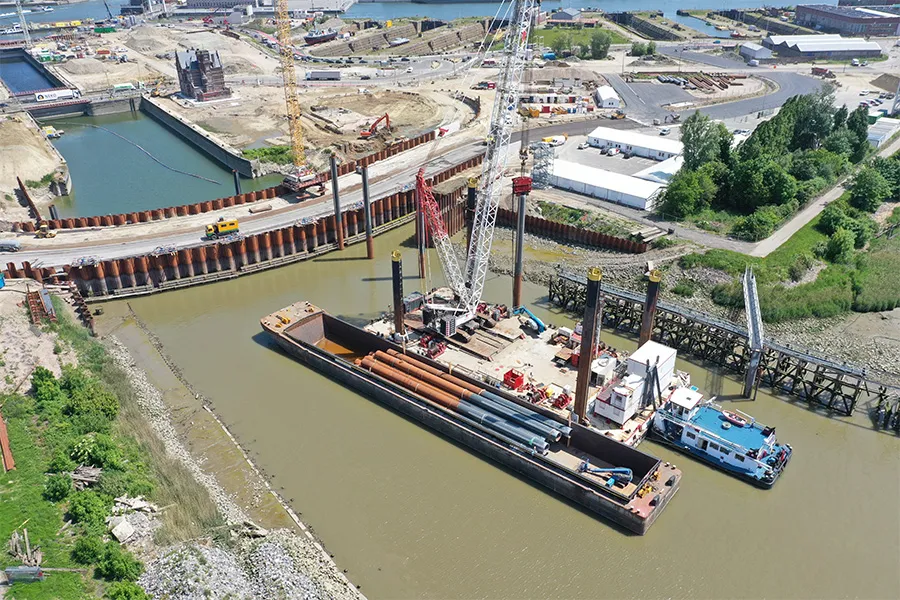
The Royerssluis is one of Antwerp’s most important locks. It is a key gateway for inland shipping, connecting the Scheldt with the Albert Canal. “However, the old lock was in need of refurbishment,” says Sofie Nullens, Royerssluis project manager at the Department of Mobility and Public Works. “It was outdated and suffered from major leakage, which led to very long lockage times. The gates and bridges also lacked redundancy. As a result, when the lock broke down, both shipping and road traffic were affected, and breakdowns were frequent. Finally, the lock was too small for the emerging four-barge push-tow traffic.”
Engine of the Flemish economy
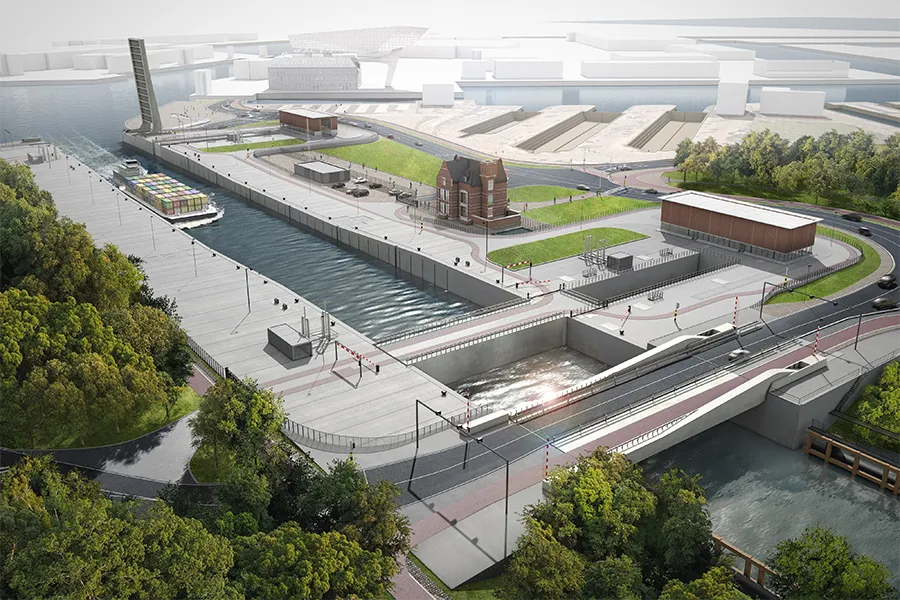
There were plenty of reasons for a transformation. And what a transformation! The existing lock is being completely replaced by a new one that is both longer and wider, allowing modern inland vessels to pass through efficiently and safely, while increasing transport capacity to the Albert Canal. “These works will help the engine of Flanders’ economy run more efficiently,” says Nullens. The new lock is not the only project in the wider area. “The Royerssluis has many technical interfaces with the Oosterweel link’s canal-zone tunnel. The tunnel passes very close to the upper head of the new lock, where the roads of the new Oosterweelknoop will connect. To minimise disruption and benefit from economies of scale, we put the works out to tender jointly and awarded the contract to the Rinkoniên consortium on the basis of price and quality. It comprises Belgian companies Artes Group, CIT Blaton and Stadsbader, and Dutch companies Mobilis and Boskalis.”
Diversion
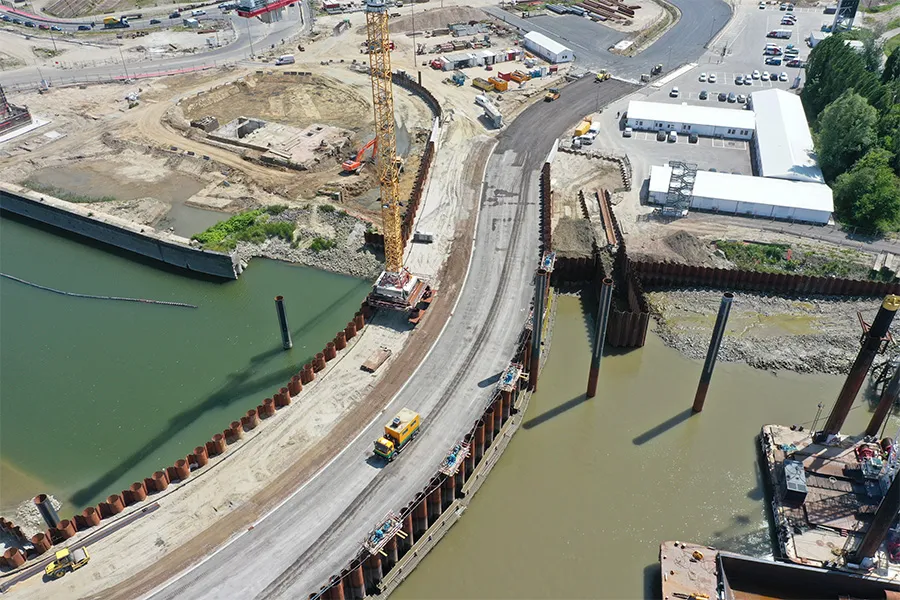
Work began in October 2021. The first vessels will be able to pass through the new Royerssluis in early 2029. The project was meticulously planned. The works also have a major impact on shipping. “We had to relocate some of the lock’s functions, and of course the old lock has been completely demolished. Inland vessels are currently being diverted via the Boudewijn and Van Cauwelaert locks, and the Berendrecht and Zandvliet lock complex. Both are large seaport lock complexes, so they are not ideal for inland shipping. Vessels also have to take a major detour. There is every incentive, therefore, to bring the Royerssluis back into service as soon as possible.” The preparatory and demolition work is now complete. “We built a cofferdam around the old lock so that we could demolish it in dry conditions and excavate the construction pit for the new lock,” says Ward Vertonghen, project director at the Rinkoniên Royerssluis joint venture.
150,000 m³ of concrete
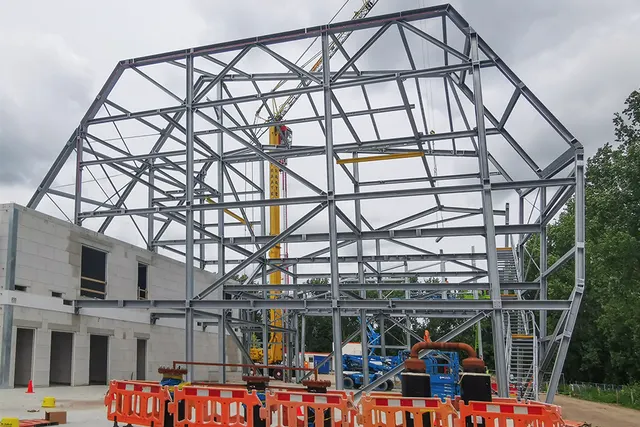
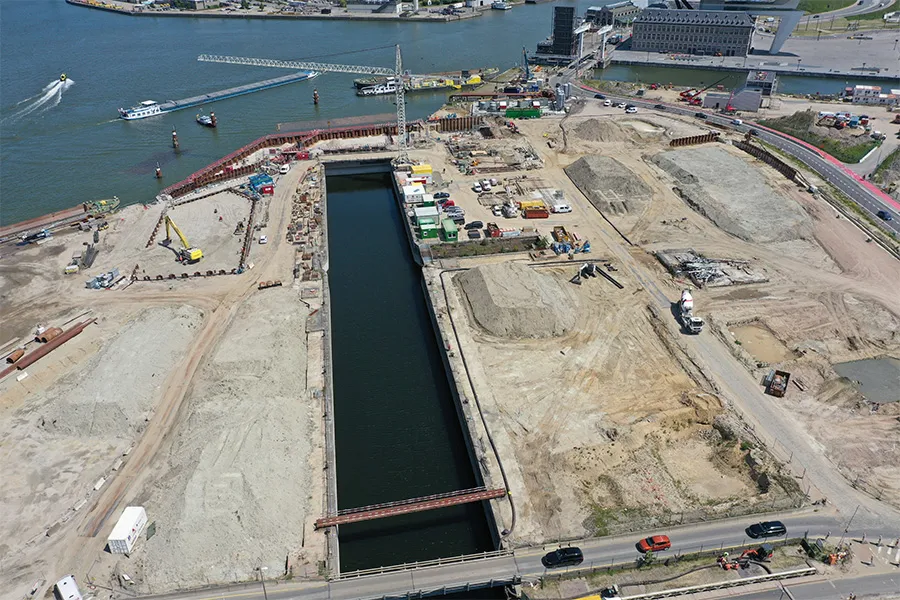
Excavating the construction pit involves moving enormous quantities of earth, more than 400,000 m³, enough to fill almost 6,000 large shipping containers. “The earthworks are in their final phase. Over the next two years, our main focus will be on the concrete work,” Vertonghen continues. The new lock will be 36 metres wide and 235 metres long. The volume of concrete to be pumped, more than 150,000 m³, is equivalent to filling over sixty Olympic-sized swimming pools. More than 25,000 tonnes of reinforcement will also be required. “Alongside the concrete structure, we are also busy preparing the steelwork and all the mechanical components, which require the necessary cast-in provisions. The lock will have a steel rolling gate at each end, weighing 1,000 tonnes on the Scheldt side and 600 tonnes on the dock side. The Scheldt-side gate is higher because of the elevated water level, and is therefore heavier. There will also be two almost identical movable bascule bridges carrying road traffic across the lock.”
Trolley principle
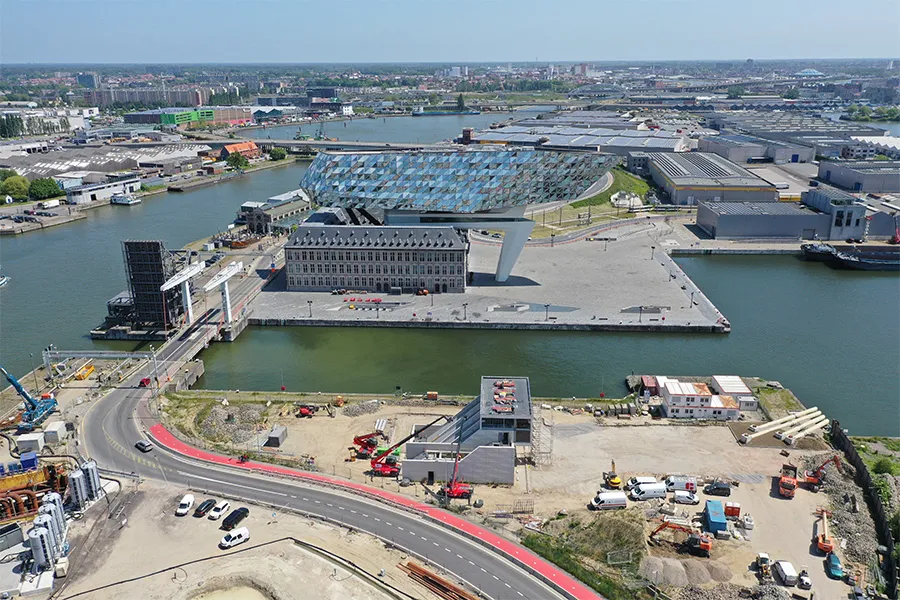
According to the current schedule, most of the concrete structure will be complete by early 2027. “We can then backfill around the lock and flood it,” Vertonghen explains. “The gates and bridges will then be installed. They are being built in parallel at Victor Buyck. The gates operate on the trolley principle, with upper and lower trolleys running on rails and hauled in and out of the gate chamber by winches in the machinery building. The gate chamber itself can be completely drained for gate maintenance.”
Nullens adds: “The gates are 10 metres wide and, in an emergency, can also be used by cyclists and cars to cross the lock if both bascule bridges are out of service. The bascule bridges are wider, of course, with two lanes for road traffic and a 4-metre-wide shared footway and cycleway. Particular attention is therefore being paid to vulnerable road users.”
Lock keeper’s house
The former lock keeper’s house is also receiving special attention as part of the project. “It now stands on an isolated island in the middle of the large construction pit. The house has been a listed heritage site since 2001 and is being incorporated into the new design to preserve the link with the past,” says Nullens. “The new lock’s nautical control centre will be housed there.” Vertonghen adds: “The house has been placed on a stable diaphragm wall structure and supported, so that it is unaffected by the lock’s structural construction work. Once the lock has been built and backfilled, we will restore the house, preserving as many historic features as possible, including the internal walls, stairs, floors and even the fireplace. In addition, we are also building two machinery buildings for the lock-gate systems and a central technical building.”
Finally, the self-closing mobile flood barrier is also worth mentioning. “If the Scheldt gate were open and suffered a failure during a severe storm, Antwerp would not be protected from extreme high water via the lock,” Nullens explains. “To address this, a self-closing mobile flood barrier is being built into the lock deck.” The new Royerssluis is scheduled for full completion in late 2028, after which the first inland vessels will be able to pass through it in early 2029.
Vraag over dit verhaal? Stel je vraag
Wie aan Royerssluis werkte
- steiger- en ondersteuningsconstructiesMatemco Hulpconstructies B.V.Genoemd in Versatile scaffolding and support systems for the Royerssluis expansion
- aannemersconsortiumTM Rinkoniên RechteroeverGenoemd in Versatile scaffolding and support systems for the Royerssluis expansion
- arbeidspartnerBELTEKGenoemd in Versatile scaffolding and support systems for the Royerssluis expansion
Blijf dit volgen
Bij een nieuw verhaal krijg je een e-mail. Geen account nodig.
- ProjectRoyerssluis
- ThemaBruggen en kunstwerken langer mee
- OnderwerpProjects